CHARGEABLE WEIGHT / KG PER M³
CBM to kg: the conversion carriers use
A cubic metre of foam and a cubic metre of tiles weigh nothing alike, so no factor turns CBM into real kilograms. What people want is the carrier's factor: the weight at which a cubic metre starts to cost more than its scale weight. That factor depends on the mode.
Updated 28 October 2026 · figures from the linked sources or computed by the Livnaro calculator with the inputs shown
Four factors, four modes
| Mode | Rule | 1 m³ counts as | Published by |
|---|---|---|---|
| Sea LCL | W/M, 1 m³ = 1 freight tonne | 1,000 kg | Maersk LCL terms, DHL Global Forwarding |
| European road groupage | 1 m³ = 333 kg | 333 kg | Posti, DHL Freight Norway |
| Express parcels | cm³ ÷ 5,000 | 200 kg | DHL Express |
| Air cargo | cm³ ÷ 6,000 | 166.67 kg | IATA |
Chargeable kg = max(actual kg, m³ × kg per m³)
kg per m³ = 1,000,000 ÷ divisor (5,000 → 200; 6,000 → 166.67)
Read it as a density break-even
Each factor is a density. Divide the gross weight by the volume: if your cargo is denser than the factor, you pay on weight; if it is lighter, you pay on volume.
- Sample cartons (the calculator's default list): 256 kg in 1.916 m³ is 134 kg/m³. That is lighter than every factor, so volume governs in all four modes.
- Floor tiles: ten 60 × 40 × 30 cm cartons at 27 kg are 270 kg in 0.72 m³, 375 kg/m³. Heavier than air (166.67), express (200) and road (333), so those charge the 270 kg actual weight; still lighter than sea's 1,000, so LCL charges 0.72 W/M on volume.
One shipment, priced four ways
The default list in the CBM calculator is 20 cartons, 1.916 m³ and 256 kg gross. The charge cards show the comparison side by side:
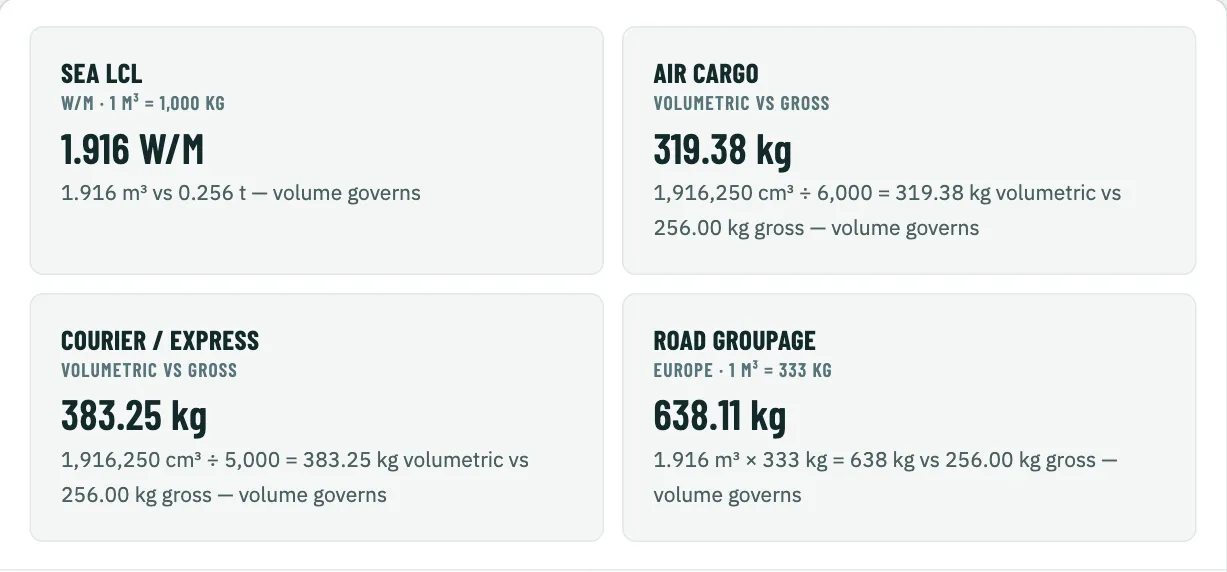
The figures are not comparable as prices: a W/M unit is priced per freight tonne, the others per kilogram, and each carrier adds minimums, rounding and surcharges. The chargeable weight calculator applies 0.5 kg or 1 kg rounding per shipment or per carton.
Two common mix-ups
- "1 CBM = 1,000 kg" is not a weight. It is the sea freight pricing rule. A forwarder quoting a road or air rate uses a different factor.
- The divisor is the carrier's, not yours. Express services quote ÷5,000; airline cargo ÷6,000. US parcel carriers state theirs in inches and pounds; Livnaro's sister site Cartpado compares 5,000 vs 6,000 and the carrier rules for DHL and FedEx.
Keep going
Guides
- LDM: what a loading metre is and when it is chargedLDM (loading metre) is the trailer floor length a load takes: length × width ÷ 2.4 m.
- CBM to cubic feet (and back)1 CBM = 35.3147 cubic feet because 1 ft is exactly 0.3048 m.
- How to calculate CBM for a shipmentCBM is length × width × height in metres, line by line.