ROAD FREIGHT / LOADING METRES
LDM: what a loading metre is and when it is charged
LDM stands for loading metre, a unit European road carriers such as Posti and DHL Freight use for freight that takes floor space but cannot share it. It turns a footprint into metres of trailer, and a chargeable weight, with one published rule.
Updated 30 October 2026 · figures from the linked sources or computed by the Livnaro calculator with the inputs shown
Use the loading metre calculator in the worksheet
The CBM worksheet includes a loading meter calculator for non-stackable pallets. Enter each pallet footprint, quantity, loaded height and gross weight; select One high (pallets) under Stacking, then choose Road in the chargeable-weight panel.
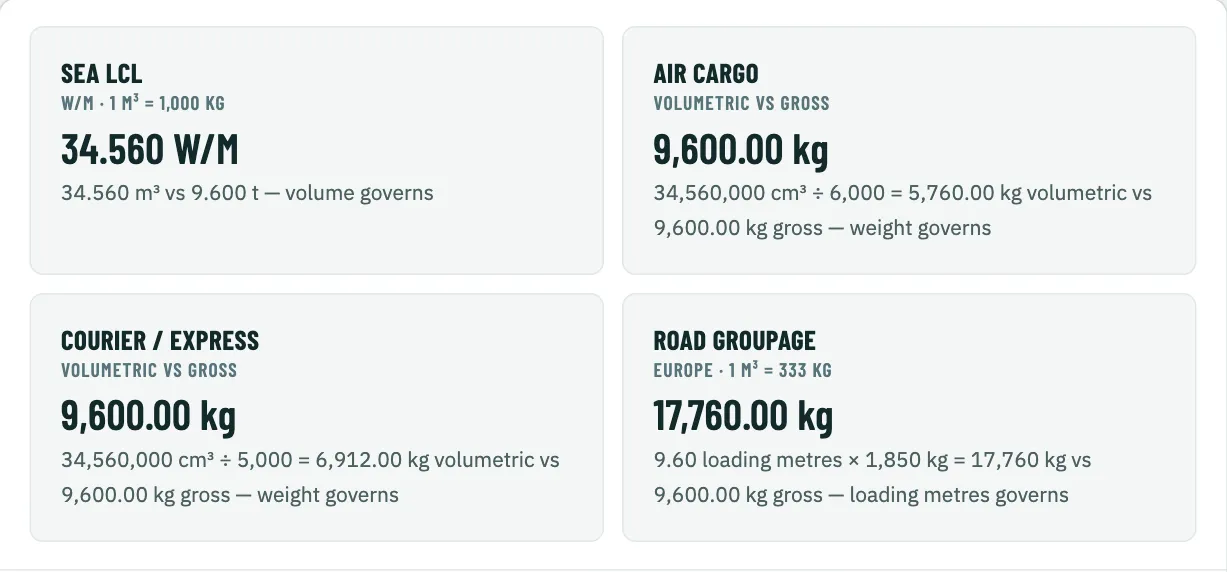
For 24 pallets measuring 120 × 80 cm, 150 cm high and 400 kg each, the result is 9.60 LDM and 17,760 kg chargeable under the displayed 1,850 kg/LDM rule. Your existing worksheet is kept when you follow the link; enter your own values to reproduce the example.
Scope: this is a floor-space and chargeable-weight estimate, not a freight price or trailer-loading plan. The worksheet applies LDM when you select One high; it does not automatically apply every tariff condition. Posti also uses loading metres for individual handling units above 2,500 kg. Check your carrier's eligibility, billing width, factors and minimum charges. Posti rules rechecked 30 October 2026.
The rule
Finland's Posti publishes it in full:
Loading metres = length × width (m) ÷ 2.4
1 loading metre = 1,850 kg chargeable · 1 m³ = 333 kg chargeable
DHL Freight Norway uses the same 333 kg per m³ and 1,850 kg per loading metre for continental Europe. Other carriers and countries use other factors, so the tariff decides.
| Unit | Footprint | LDM | Chargeable |
|---|---|---|---|
| EUR pallet | 120 × 80 cm | 0.4 | 740 kg |
| FIN pallet | 120 × 100 cm | 0.5 | 925 kg |
| Half pallet | 80 × 60 cm | 0.2 | 370 kg |
When LDM applies instead of m³
Posti charges on cubic metres when a unit is at most 1.3 m high and 5 m long, can be stacked, and is on a pallet (or weighs no more than 35 kg). It charges on loading metres when the unit is taller or longer, must not be stacked, or is not on a pallet. Either way the actual weight applies when it is higher. In short, LDM charges for the floor a unit blocks for everything else.
Same 24 pallets, three charges
- Stackable, 1.2 m high, 400 kg each. 24 × 1.2 × 0.8 × 1.2 = 27.65 m³ × 333 = 9,207 kg. Actual weight is 9,600 kg, so 9,600 kg is charged.
- Not stackable, 1.5 m high. 24 × 0.4 = 9.6 LDM × 1,850 = 17,760 kg, against 11,508 kg by volume and 9,600 kg actual. LDM governs and the charge nearly doubles.
- Light goods, stackable. When the pallets weigh 150 kg each, 3,600 kg actual sits below 9,207 kg by volume, and volume is charged.
Try it in the CBM calculator: the same setting makes the container panel count floor positions too. The pallet guide covers containers.
Keep going
Guides
- How many pallets fit in a 40 ft containerFloor counts for EUR, 120 × 100 cm, 48 × 40 in and half pallets in 20ft, 40ft, 40HQ and 45HC containers, worked from inside dimensions, with clearance and double stacking.
- CBM to kg: the conversion carriers useThere is no physical CBM to kg conversion.
- Container weight limits: which number appliesA 40ft GP's payload depends on who rated it: 26,840 kg (ONE) or about 28,800 kg (SeaCube, Maersk).