PALLETS / FLOOR POSITIONS
How many pallets fit in a 40 ft container
A pallet load is decided by the floor, not by cubic metres. These counts come from each container's published inside dimensions and each pallet's footprint, laid out the way a loader would: some rows one way round, the rest of the width the other way.
Updated 30 October 2026 · figures from the linked sources or computed by the Livnaro calculator with the inputs shown
The short answer
One tier of pallets, no gap between pallets or walls. The 20', 40' and 40' HQ inside sizes are SeaCube's (20' dry, 40' dry, 40' high cube); the 45' HC is ONE's 13,556 × 2,352 mm floor.
| Pallet footprint | 20' GP | 40' GP | 40' HQ | 45' HC |
|---|---|---|---|---|
| EUR, 1,200 × 800 mm | 11 | 25 | 25 | 27 |
| 1,200 × 1,000 mm | 9 | 22 | 22 | 24 |
| 48 × 40 in (1,219 × 1,016 mm) | 9 | 20 | 20 | 24 |
| Half pallet, 800 × 600 mm | 25 | 55 | 55 | 60 |
A 40' HQ has the same floor as a 40' GP, so it holds the same number of pallets in one tier. The extra 30.5 cm of height only matters when pallets can be stacked (below).
Why 25 EUR pallets, not 24
The EPAL Euro pallet is 1,200 × 800 mm. A 40' GP is 12,032 mm long and 2,352 mm wide inside. Two pallets side by side with their long sides along the box take 1,600 mm of width and waste 752 mm; with their long sides across, only one fits (1,200 mm) and 1,152 mm is left.
The better layout mixes the two. One row turned across the box (1,200 mm of width, 800 mm of length each) holds ⌊12,032 ÷ 800⌋ = 15 pallets. The remaining 1,152 mm of width takes one row the other way round (800 mm wide, 1,200 mm long): ⌊12,032 ÷ 1,200⌋ = 10. That is 25. The same reasoning gives 7 + 4 = 11 in a 20' GP (5,898 mm long).
Floor positions = rows × ⌊inside length ÷ pallet length in that row⌋, summed over the rows that fit across the width
Published counts are usually lower: the sources on Livnaro's container data sheet give 23 to 25 EUR pallets for a 40' GP, most often 24. Clearance changes the count. Give each pallet 2 cm of play (1,220 × 820 mm) and the same layout drops to 14 + 9 = 23 in a 40' GP, while the 20' GP keeps 11. The worksheet finds this 25-pallet arrangement without gaps; it does not prove a global optimum or check loading access. Plan on 23–24 unless your loader confirms the tighter arrangement.
Stacked pallets: where the high cube pays
When the goods allow a second tier, height decides. With EUR pallets the counts become:
| Loaded pallet height | 20' GP (2,393 mm) | 40' GP (2,393 mm) | 40' HQ (2,698 mm) |
|---|---|---|---|
| 1.10 m | 22 | 50 | 50 |
| 1.20 m | 11 | 25 | 50 |
| 1.30 m | 11 | 25 | 50 |
| 1.40 m | 11 | 25 | 25 |
From 1.20 m to 1.34 m per loaded pallet, only the high cube takes two tiers, so it carries twice as many pallets as a 40' GP. Check the weight before you count on it: 50 pallets at 560 kg each is 28,000 kg, close to the 28,750 kg SeaCube rates its 40' HQ for. See container weight limits.
Run your own pallets
In the CBM calculator, enter each pallet type as a line with its loaded height and weight, then set field 6 Stacking to One high (pallets). The container panel adds a Floor bar and limits each container by floor positions as well as volume and weight. Also compare adds a 45' HC or a reefer from the data sheet.
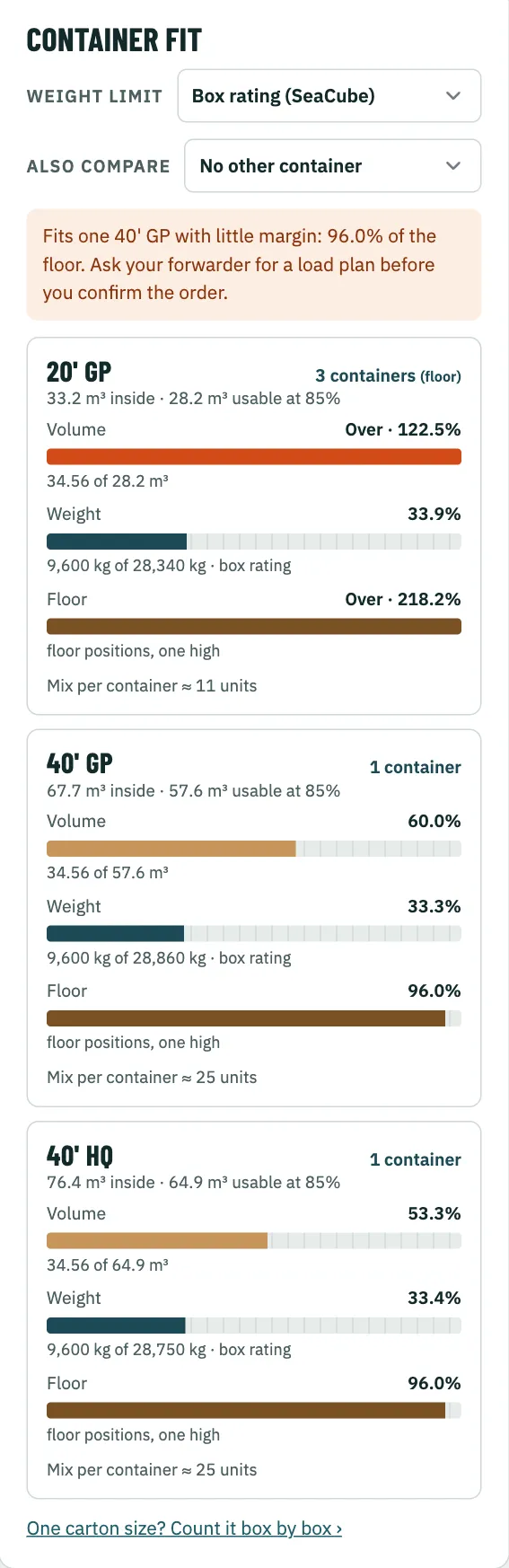
The same input also drives the road card, which charges unstackable pallets by loading metre; the LDM guide explains that rule.
Keep going
Guides
- Container loading calculator: what a free tool can answerWhat a free container loading calculator can work out (volume fill, turned-carton counts with drawings, pallet floor positions, weight, mixed container sizes) and what still needs a load plan.
- Container weight limits: which number appliesA 40ft GP's payload depends on who rated it: 26,840 kg (ONE) or about 28,800 kg (SeaCube, Maersk).
- LDM: what a loading metre is and when it is chargedLDM (loading metre) is the trailer floor length a load takes: length × width ÷ 2.4 m.