ROAD / TRAILER FLOOR
How many pallets fit in a 53-foot trailer
The answer depends on which way the pallets face. A 48 × 40 in pallet is 8 inches longer one way than the other, and over 53 feet those inches add up to two whole rows.
Updated 2 November 2026 · figures from the linked sources or computed by the Livnaro calculator with the inputs shown
The short answer
ATS gives a 53-foot dry van 636 inches of cargo length, 98 to 100 inches of width and 108 to 110 inches of height, and these counts for 48 × 40 in GMA pallets in one tier:
| Loading | How it divides | Pallets |
|---|---|---|
| Straight, 48 in along the trailer | ⌊636 ÷ 48⌋ = 13 rows × 2 | 26 |
| Pinwheeled, alternating direction | ATS's figure | 28 |
| Turned, 40 in along the trailer | ⌊636 ÷ 40⌋ = 15 rows × 2 | 30 |
Turned pallets need 2 × 48 = 96 inches of width, which fits even the 98-inch end of that range, with 2 inches to spare. That margin is thin for forklift work and for pallets with overhang, so check the trailer you are booked on before you promise 30.
The weight limit comes first for heavy pallets
ATS puts the cargo limit of a 53-foot dry van at 42,000 to 45,000 lb, against the 80,000 lb limit on the loaded truck; elsewhere in the same article it gives 44,000 to 47,000 lb. The lower range is used here. Divide it by the floor count and you get the average weight each position can carry:
| Pallets | At 42,000 lb | At 45,000 lb |
|---|---|---|
| 26 | 1,615 lb | 1,730 lb |
| 30 | 1,400 lb | 1,500 lb |
Above those averages, the floor is not what stops you. For heavy freight ATS also describes alternating a double row of pallets with a single row, to spread the weight along the trailer. Ask the carrier how to place it: this page counts floor positions and does not work out axle loads.
Against a 40-foot container and a 13.6 m trailer
All counts below are floor positions with no clearance, worked out by the Livnaro worksheet from the inside sizes shown.
| Pallet footprint | 40' HQ 12.03 × 2.35 m | 13.6 m trailer 13.62 × 2.48 m | 53' dry van 16.15 × 2.54 m |
|---|---|---|---|
| 48 × 40 in | 20 | 26 | 30 |
| EUR, 1,200 × 800 mm | 25 | 34 | 40 |
| 1,200 × 1,000 mm | 22 | 26 | 32 |
The 13.6 m figures use DP World's Euroliner, which it lists at 33 Euro pallets and 26 UK pallets, 87 m³. LKW Walter lists its curtainsiders at up to 34 Euro pallets and up to 25.5 tons of payload. The 33 is three pallets across, 11 rows; the 34 is two across with the long side over the width, 17 rows. The worksheet finds the 34 because it allows no clearance.
Run your own pallets
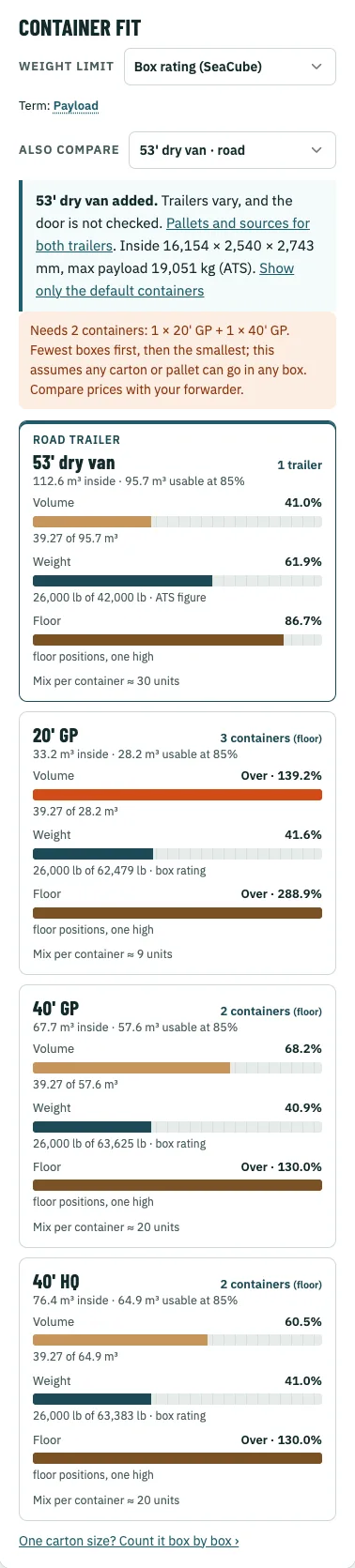
In the CBM calculator, enter one line per pallet type with its loaded height and weight, set Stacking to One high (pallets) in the settings, and choose 53' dry van or 13.6 m trailer under Also compare in the container panel. The trailer gets its own floor, volume and weight bars next to the containers. It uses the 100-inch width, 108-inch height and 42,000 lb from the ATS figures; type your own limit if the carrier gives you one.
For a load that does not fill a trailer, US less-than-truckload is priced by class: the freight class calculator gives density and the estimated class. European groupage is often priced by the metre of floor: see the LDM guide.
Keep going
Guides
- How many pallets fit in a 40 ft containerFloor counts for EUR, 120 × 100 cm, 48 × 40 in and half pallets in 20ft, 40ft, 40HQ and 45HC containers, worked from inside dimensions, with clearance and double stacking.
- LDM: what a loading metre is and when it is chargedLDM (loading metre) is the trailer floor length a load takes: length × width ÷ 2.4 m.
- Container weight limits: which number appliesA 40ft GP's payload depends on who rated it: 26,840 kg (ONE) or about 28,800 kg (SeaCube, Maersk).